
Winds of the Adriatic
Master the Adriatic winds and enhance your sailing experience. Understanding these local wind patterns is essential for safe and enjoyable sailing along the Croatian coast.
Adriatic wind rose
Lorem ipsum dolor sit amet, consectetur adipiscing elit. Ut elit tellus, luctus nec ullamcorper mattis, pulvinar dapibus leo.
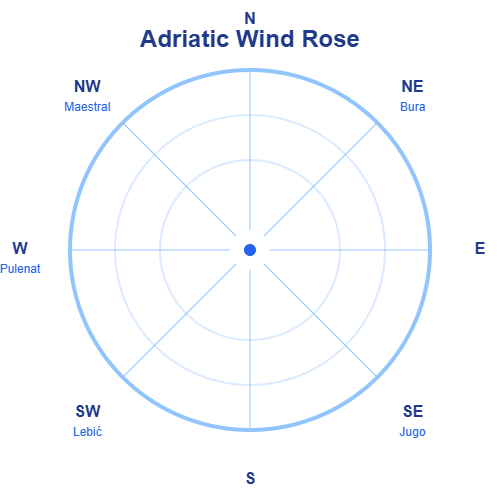
Adriatic wind rose
Bura
NE Wind
Characteristics:
Gusty, dry, clear weather, short steep waves
Description:
Bura is a cold, dry wind that blows from the northeast, coming from inland toward the sea. Known for its sudden gusts and strong intensity, Bura often brings clear skies but can make the sea choppy and unpredictable. It’s especially common in the northern Adriatic and is a wind that demands respect from sailors.
Sailing Tip
Always check the forecast in advance. Bura can arrive suddenly
Jugo
SE Wind / Scirocco
Characteristics:
Moist, overcast, stable build-up, long swell
Description:
Jugo is a warm, humid wind from the southeast, often bringing clouds, rain, and longer rolling waves. It builds gradually over hours or days and is more predictable than Bura. Jugo is typical in southern and central parts of the Adriatic and can last for several days.
Sailing Tip
Great for sailing with preparation, but monitor conditions for longer passages
Maestral
NW Wind
Characteristics:
Mild to moderate, regular, clear weather
Description:
The Maestral is a sailor’s favorite, a daily summer breeze from the northwest that typically begins around noon and fades by early evening. It forms due to temperature differences between land and sea and offers ideal sailing conditions along the Croatian coast.
Sailing Tip
Perfect for afternoon sailing and island hopping
Burin
Night Breeze
Characteristics:
Light wind, cooler air, occurs after sunset
Description:
Sailing Tip
Nice for overnight anchorages. Enjoy the cooler air after a hot day
Nevera
Storm Front
Characteristics:
Sudden squalls, thunder, unpredictable gusts
Description:
Nevera is not a wind direction but rather a sudden, intense storm — usually accompanied by thunder, lightning, heavy rain, and violent gusts. It can appear unexpectedly and from different directions, often due to the clash of cold and warm air masses.
Sailing Tip
Perfect for afternoon sailing and island hopping
Pulenat
W Wind
Characteristics:
Fresh west wind, short duration
Description:
Pulenat, also known as Ponente, is a westerly wind that doesn’t occur often or last long, but when it does, it usually signals a shift in weather. It’s more common in the central Adriatic.
Sailing Tip
Often a warning sign of an approaching change in conditions
Lebić
SW Wind
Characteristics:
Strong, stormy, choppy sea
Description:
Lebić is a rare but powerful southwesterly wind that can bring rough seas and stormy weather. It’s particularly challenging for anchorages exposed to the southwest and can appear quickly in certain regions.
Sailing Tip
Choose protected bays and avoid southwest-facing anchorages when Lebić is expected
Adriatic wind rose
Before you sail
- Check local weather forecasts and wind predictions
- Monitor VHF radio for weather updates
- Plan alternative routes and safe harbors
- Inform marina staff of your sailing plans
While sailing
- Watch for sudden cloud formations
- Be prepared to reduce sail quickly
- Keep safety equipment easily accessible
- When in doubt, seek shelter early